

 Gallery: Harlequin Great Danes
Great Dane growth ─
not an issue of so-called "torture breeding".
For 150 years, it has been known that Great Danes must be fed correctly.
Love does not always have to be expressed through food!
More information: Feeding puppies - Feeding Great Danes
Weight and height development
from Great Dane puppy
to fully grown Great Dane
am Beispiel von Indra vom Gehrensee.
Photo documentation of Indra vom Gehrensee
12 years in the life of a Great Dane
Indra vom Gehrensee"
Date of birth: 5 September 2011 - Birth weight: 560 g - Sire: Damarkann Dubai Venture - Dam: Hera vom Gehrensee
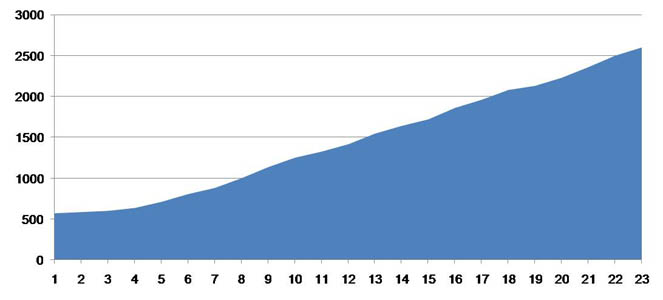
Key: x-axis (bottom) = time in days / y-axis = body weight in grams
| Birth: | Caesarean section – Small Animal Clinic, Free University of Berlin | ||
| Mother`s milk: | consistently available in ample quantities | ||
| Care provided by the dam: | excellent from the fourth day onwards | ||
| Supplementary feeding: | not necessary during the first three weeks | ||
| Average weight gain: | approximately 100 g per day from the second week onwards | ||
| Worming: | "Panacur", 2 ml three times, followed by treatment at regular intervals | ||
| Photographs as visual documentation: | https://www.doggen-vom-gehrensee.com/doggen_welpen_portraits.htm | ||
| Notes: | Weight losses of up to 10%, or very small gains during the first few days, are usually attributable to humidity levels below 55% in the puppy room. (The optimum humidity is 65%.) | ||
| From day 23 onwards, Indra was given supplementary puppy porridge (puppy food formulated for large breeds). | |||
A Great Dane`s weight during the first 18 months of life
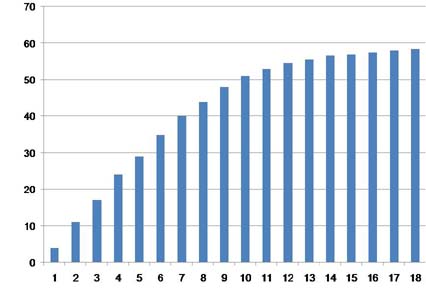
Key: x-axis (bottom) = time in months / y-axis = weight in kg / measured at the end of each month
When planning the feeding programme, the priority was health and therefore achieving an
optimal weight during the first year of life.
Here is a quotation from
Meyer/Zentek 2005
on the subject of weight development:
“During rearing, the aim should be optimal rather than maximum growth rates. This does not mean that a young dog should be underfed during its development."
Indra was fed three different types of food (Puppy, Junior and Adult, all premium-quality products).
The commercial foods used had been specially developed for raising large breeds.
In summary, the use of our "Puppy" and "Junior" foods resulted in very moderate weight development. The use of the energy-rich "Adult" food brought the weight development to its conclusion.
The weight development shown is that of a female Great Dane. Indra has an athletic build. Given her height, she reaches an optimal adult weight of 60 kg at 21 months.
Height development of a Great Dane
("Indra vom Gehrensee" – Sire: Damarkann Dubai Venture – Dam: Hera vom Gehrensee)
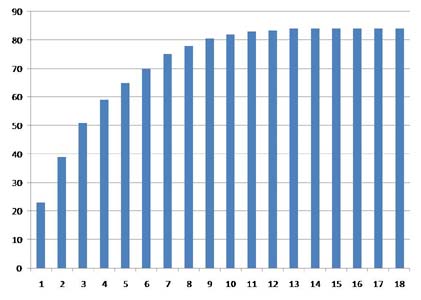
Key: x-axis (bottom) = time in months / y-axis = height at the withers in centimetres / measured at the end of each month
The growth curve above shows the height development of our female Great Dane, "Indra", despite restricted feeding. In terms of height development, Indra shows figures more typical of males.
Adult height is genetically determined. Indra`s height at the withers is 84 cm. The results clearly demonstrate the great responsibility borne by both the Great Dane breeder and the puppy buyer during the rearing period. Our aim: Here are four important quotations from Dr Füglistaller`s dissertation, section 6.2.4, "Great Danes": Further information: The height of the Great Dane
Feeding was based on growth charts for weight development in Great Danes. The reference material included Carmen Füglistaller`s doctoral dissertation at the Vetsuisse Faculty of the University of Zürich, as well as comparable weight data supplied by the manufacturer of our premium dog food. Between the ninth week and the ninth month of life, feeding was "mildly restricted". In other words, we reduced the amount of food to bring the puppy`s weight into line with the recommended figures in relation to the growth rate of Great Danes.
Dr Füglistaller`s dissertation assumes that most Great Danes are too heavy during the growth phase as a result of being fed on an "ad libitum" basis.
Our weight figures, however, are almost identical to those provided by our premium food manufacturer for the growth rate of giant breeds weighing 45 kg or more.
Growth data must be considered individually. The growth charts (weight and height) can be applied to other Great Danes only in terms of their general pattern.
Differences in the shape of the curves result from genetic predisposition, the composition of the food, the amount fed and the dog’s sex. In addition, during the cold season, higher weight values should be aimed for when a dog is kept outdoors. A young Great Dane needs energy to develop subcutaneous fat.
Cutting corners on food quality is contrary to Section 2(1) of the German Animal Welfare Act. The feeding of Great Dane puppies illustrates an old breeder’s rule particularly well: "Mistakes made during rearing can never be fully put right later."
Height development:
The rate at which body height (height at the withers) increases depends primarily on age and genetic predisposition. Great Danes grow fastest during the first three months of life. It is not easy to determine exactly how long growth continues. Whether a Great Dane grows for 11, 12, 13 or 14 months is of little significance, as the increase in height at that age is very small. Since Great Danes grow in small spurts during puppyhood and adolescence, their final height should not be determined too early. The last small growth spurt often occurs in the middle of the second year of life. During the first two months, growth appears fairly even, and growth spurts are hardly noticeable.
Great Danes also grow from back to front. This means that, for a time, the hindquarters may be higher than the withers. The head grows slowly and later. Excessive loose skin combined with a small skull can lead to exposed eyes (ectropion).
Depending on their expected adult height, relatively small Great Danes grow upwards considerably more slowly than the larger representatives of the breed.
As warnings are repeatedly issued about rapid growth, particularly in connection with certain expensive premium foods, I would like to make one point clear:
For some breeders, the problem is not the quality of the food but its price. Quite a few breeding operations are commercially oriented; in such cases, profit is the main concern.
In my 30 years of breeding Great Danes, based on maximum genetic diversity and without buying in outside dogs, I have so far had no problems with the height development of my dogs. The situation may be quite different in inbred dogs. As a rule, blame for problems is usually placed elsewhere. In quite a few cases, the food is held responsible.
In my experience, maintaining the correct phosphorus─to─calcium ratio is most important.
I agree with the view of Meyer/Zentek that problems arise when a Great Dane is pushed to gain substance through high-energy feeding. However, it must be borne in mind that active Great Danes need considerably more energy in the form of fat in their diet. The same applies to Great Danes kept outdoors during the cold season.
Because the Great Danes from Gehrensee are robust (not inbred), the main focus when raising my own breeding dogs is on socialisation and training the puppy.
As breeders, we place great importance during rearing on steady weight gain and on a slim, relatively lightweight type of Great Dane. This is intended to avoid unnecessary strain on the musculoskeletal system. We do not attempt to manipulate genetically determined height growth by changing the composition of the food.
The charts make it clear that the musculoskeletal system cannot yet be strong (in the sense of being able to withstand strain), particularly during the period of rapid height growth up to the ninth month. For this reason, a Great Dane running freely in public should be kept under control during the growth phase. Great Danes should not begin training until they are at least 12 months old.
Swimming is an exception. Since swimming reduces strain on the musculoskeletal system, we start swimming training with our young Great Danes during their first year of life.
"According to Meyer and Zentek (2005), the average birth weight of Great Danes is 567 g."
"Meyer and Zentek (2005) assumed an adult weight of 60 kg for males and 55 kg for females." Breeder`s note:
These weight figures can only refer to the traditional Great Dane. The type of Great Dane newly developed by the VDH is considerably heavier."
"...This confirms that, compared with other giant breeds, the Great Dane has a higher energy requirement (Rainbird and Kienzle, 1990)."
"According to Meyer and Zentek (2005) and Case et al. (1997), excessive crude protein intake is a problem only when accompanied by excessive energy intake."
Recommended growth curves for young dogs during their first year of life, for monitoring their growth (from MEYER and ZENTEK 2005)
Source: page 5, Fig. 1
"Studies on the energy digestibility and energy requirements of growing dogs in relation to breed and calcium supply"
Doctoral dissertation submitted to the Faculty of Veterinary Medicine at Ludwig Maximilian University of Munich by Viktoria Frank, from Radebeul
There are repeated public claims about the height of the Great Dane that are based on rumours. In addition, fictional figures are sometimes used in advertising. Nevertheless, here are a few general points: Weight, height and health in Great Danes
On 20 December 2012, the breed standard specified both a minimum and a maximum height for Great Danes. Male Great Danes should therefore measure between 80 cm and 90 cm at the withers (shoulder height). Females should be at least 72 cm and no more than 84 cm.
Statistically speaking, a male Great Dane can be considered tall if he measures 89 cm or more at the withers. The growth of tall male Great Danes generally ends at a height of 92–95 cm at the withers. Exceptions are known.
The range for a tall female Great Dane can be defined somewhat more precisely. It starts at the minimum height for males (80 cm) and generally ends at 85 cm at the withers.
Discussions about exceptionally huge Great Danes measuring more than 92–95 cm at the withers may be interesting, but they are entirely beside the point as far as the purpose of the standard and practical breeding are concerned.
Maximum height in Great Danes is primarily a media topic. I do not know any breeder who aims for maximum height. Very large Great Danes are not harmoniously built; they lack nobility, and there is no question of elegance. Such overgrown "giants" invariably receive poor ratings at shows. In addition, the owners of these giants often have problems with feeding. Photos and videos of such dogs quite often show bony, undernourished animals that have been given completely unsuitable food. The balance of protein, carbohydrates, fat and minerals must be appropriate.
There are many different hypotheses about the effects of height on health. Some concerns are based on genuine worries about the health of our beloved Great Dane; other claims come from lobbyists. Hip assessment of three young dogs at four months of age To monitor growth and inheritance, the hips of Lars, Lola and Lena vom Gehrensee were X-rayed several times under anaesthesia during their fourth month of life, including examinations using the PennHIP method for the early detection and diagnosis of hip dysplasia. The Norberg angle provides an important indication of hip condition. The following values were measured: Lars: right 115 degrees, left 112 degrees / Lola: right 107 degrees, left 109 degrees / Lena: right 118 degrees, left 117 degrees. All these values are above 105 degrees, allowing an optimistic outlook for the further development of the hips and the prospect of being free from hip dysplasia. What should be borne in mind?
Here are a few basic observations:
It would be very one-sided to attribute breed-related health problems solely to a Great Dane’s height. Overall body weight is just as relevant as height.
As a rule, very tall Great Danes tend to have an athletic build and therefore fall only in the middle range of the population in terms of body weight.
The really heavy Great Danes are not those of the "Great Dane" type, but the smaller and medium-sized dogs whose type tends towards the "Mastiff". The forces acting on their bodies are fundamentally different.
Where the “long levers” are significant in very tall Great Danes, it is the greater overall mass of the considerably smaller “Mastiff-type Great Danes” that matters.
to monitor growth and inheritance.

- Do not buy a Great Dane puppy from a breeding programme in which dogs with even mild hip or elbow dysplasia have repeatedly been used for breeding.
- During a Great Dane puppy’s rapid growth phase, ensure appropriate nutrition and moderate exercise.
- Gastric torsion: Great Danes should be fed several small meals throughout the day.
- When an adult Great Dane plays off the lead with other dogs, keep the play under control so that excessive forces are avoided (prevention of sports injuries).
- The adult Great Dane`s overall body weight should be kept within reasonable limits (this is not a weight competition).
© by Günter Diessel / Reproduction or reuse, including in part, is permitted only with the author`s express consent.