

 Gallery: Harlequin Great Danes
What is not learned in puppyhood
is much harder to learn later!
Exercise programme
Developing and fostering healthy social behaviour
in our breeding Great Danes
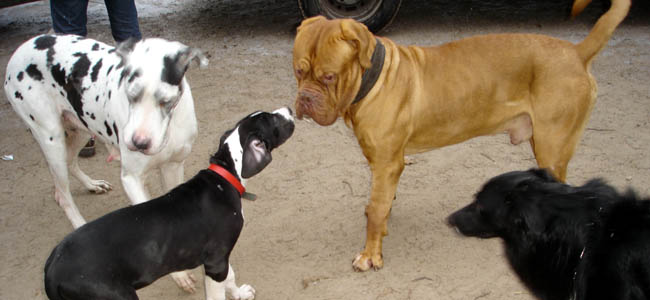
The following programme is primarily concerned with helping a companion dog cope emotionally with the stressors of life in a major city.
Fostering social behaviour during puppyhood helps prevent behavioural problems in the adult Great Dane.
If a Great Dane is familiar with canine social behaviours such as nose-to-nose contact, anogenital investigation and the display behaviour of unfamiliar dogs, it is less likely to overreact out of fear later on. From the perspective of developing social skills, keeping a dog constantly on a lead is entirely counterproductive.
We expect more of our Great Danes than simply becoming accustomed to their family, home and garden, the Great Dane club grounds and the show ring.
What have we achieved over the last four generations of Great Danes, and what do we expect in the future?
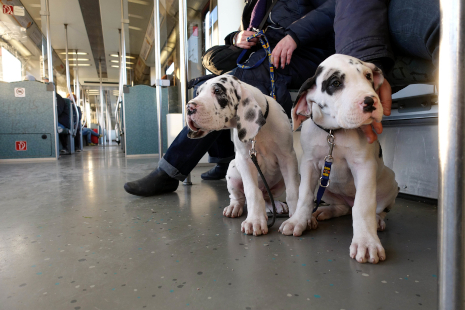
- Our breeding bitches are very open towards strangers. Growling at or barking at visitors is not part of their temperament. In public, they allow strangers to touch and pet them. They are not afraid of large crowds and remain calm if accidentally jostled in a crowded underground or suburban train.
- All our breeding Great Danes enjoy travelling by car, regardless of the distance. We have already travelled with our dogs by car to Vienna, Venice, Rome, Rotterdam and Warsaw.
- They are friendly towards other dogs, regardless of breed, size or sex. They invite unfamiliar dogs to play and show considerable enthusiasm in competitive situations.
- Our Great Dane bitches are easy and reliable to handle, both on and off the lead.
- When encountering wild boar, our breeding Great Danes have so far remained composed and steady-nerved. They could be called back on command.
- Like most Great Danes, they are very affectionate and family-oriented.
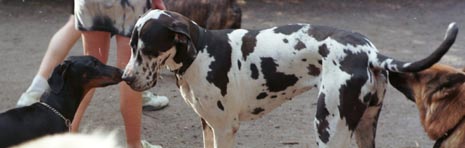
Although the traits I have listed are part of the genetic potential of our breeding line, they must be developed during puppyhood.
If this developmental stage is missed, problems may result – for example, an entirely inappropriate reaction to Jack Russell Terriers.
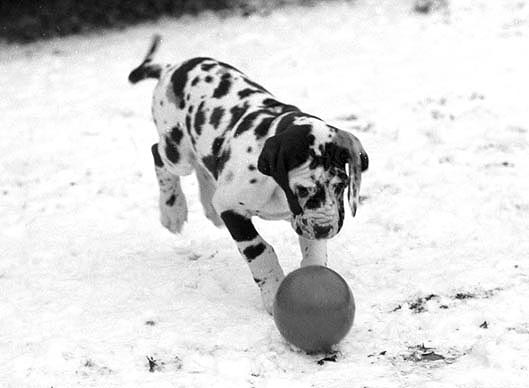
The following exercise programme summarises
experience gained from successfully raising seven generations of Great Danes.
Exercise programme
This exercise programme is designed to develop a Great Dane that can cope confidently with everyday life.
This is not a dog sport programme!
| 4th–7th week of life | Getting accustomed to car travel (without getting in and out of the vehicle) | ||
| from the 8th week of life | Getting accustomed to walking calmly on a lead and wearing a collar in public (first vaccination at 6.5 weeks) | ||
| from the 9th week of life | Introducing the command: “Stop” (interrupting a movement sequence before calling the dog back) | ||
| from the 9th week of life | Getting accustomed to water: showering to become accustomed to water and for body care. | ||
| from the 9th week of life | Teaching the Great Dane puppy appropriate behaviour inside the home. Establishing the pack order (owner = pack leader) | ||
| from the 9th week of life | Introducing the command: “Leave it” (stopping an unwanted action) | ||
| from the 9th week of life | Getting accustomed to all forms of public transport in Berlin (second vaccination at 10 weeks) | ||
| from the 9th week of life | Getting accustomed to places with large crowds: railway stations, shopping centres, markets and demonstrations | ||
| from the 10th week of life | Introducing the command: “Come” / recall training off the lead in open countryside. | ||
| from the 11th week of life | Getting accustomed to water in lakes or streams, depending on weather and season / getting used to a rowing boat | ||
| from the 11th week of life | Getting accustomed to all breeds of dog and all age groups, including so-called listed breeds, off the lead (second polyvalent vaccination at 10 weeks) | ||
| from the 13th week of life | Recall training off the lead in a designated dog exercise area. | ||
| from the 13th week of life | Introducing the command: “Sit” | ||
| from the 17th week of life | Introducing the commands: “Heel”, “Down” and “Stay”. |
||
| --------------- | |||
| from the 5th month of life | More intensive heelwork. Through socialisation, the Great Dane has become more self-confident. It therefore no longer stays quite so close to its owner. The aim now is to walk with a loose lead. |
||
| from the 5th month of life | Show training | ||
| from the 5th month of life | Spending time off the lead in designated dog exercise areas has become something our Great Danes enjoy well into old age. | ||
| At this age, our Great Danes are already suitable travel companions for holidays, provided that the amount of walking is reduced. --------------- |
|||
| from the 8th month of life | Start of training at a dog school in preparation for a basic obedience and companion-dog test. The first test is usually taken at 12 months. | ||
| Starting formal training at a dog club relatively late is beneficial, since social behaviour between dogs of different breeds is generally | |||
| not part of the training curriculum. The main focus is the dog’s obedience to its handler’s commands. | |||
If poorly socialised dogs encourage aggressive behaviour in the Great Dane, it is better to stop the training. Problem dogs, fighting and overly rough play are counterproductive to the positive development of a young Great Dane! |
|||
| Great Dane club grounds: In my experience, specialised training grounds for Great Danes focus primarily on | |||
| show activities and the associated ring training. Contact with other breeds is the exception. | |||
| A companion-dog test or tracking-dog training is possible, but not the norm. | |||
| The most important aspect of training at a dog school is that quite a few owners themselves need to learn how to act as pack leaders. A lack of leadership skills can lead to problems with authority. Examples include pulling on the lead or a Great Dane obeying only when it is in the mood. Even Great Danes with excellent natural dispositions must be kept under control. That is what the public expects of every owner of a large dog. |
|||
| from the 12th month of life | Physical exercise: for example, alongside a bicycle or next to a sport horse. | ||
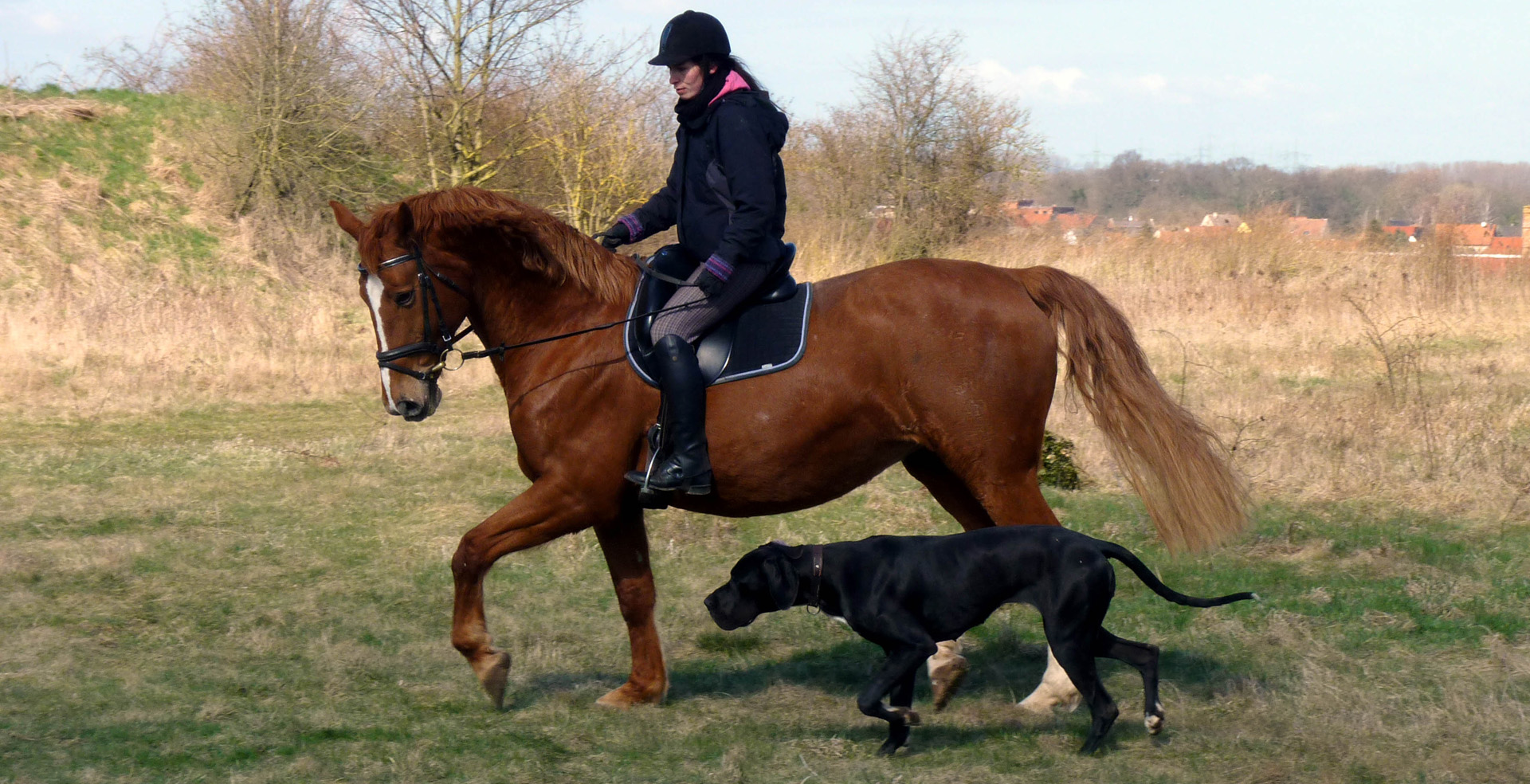
This exercise programme for our Great Dane puppies provides excellent preparation for the highly practical assessment requirements of the dog handler’s licence, as set by recognised trainers of the
BVZ or the
BVH. Feedback from Great Dane gatherings
For the first time, an examination requires dogs of different breeds to demonstrate sound social behaviour off the lead.
The programme above is based on the following stages of canine development:
Imprinting period (weeks 4–8), socialisation period (weeks 8–12), ranking phase (months 3–5).
As a Great Dane breeder, I have also taken breed-specific and preventive health aspects into account.
This means avoiding excessive strain from walking by making use of different forms of transport.
The very important element of obedience for Great Danes is incorporated throughout all socialisation exercises.
This begins with walking on the lead and progresses to recall exercises off the lead.
Obedience is central to teaching appropriate behaviour inside the home.
For this reason, the term “education” is used rather than “getting accustomed to …”.
Unlike at the dog club training ground, a Great Dane is much more motivated to comply with obedience requirements in public.
This programme is entirely free of “club constraints”. By this I mean not only a strict hierarchy in matters of authority and expertise, but above all the financial interests of clubs, such as course fees or membership dues.
As a Great Dane breeder, I have successfully used this programme over several generations of Great Danes.
It is based on experience gained in animal welfare concerning the development of social behaviour in dogs.
Financial interests play no part.
Furthermore, the very skills required in the
temperament assessment for dogs classified as dangerous are already practised during puppyhood.
The Gehrensee Great Dane gatherings provide clear feedback on the resilience and social suitability of our breeding line.
Caution!
Practice and training can only develop traits that are genetically present. Great Danes from breeding lines
that have been kept away from other breeds for many decades often have few firmly established predispositions for social interaction with unfamiliar breeds.
With such Great Danes, being off the lead under stressful conditions can cause enormous problems!
Here are a few examples of temperament problems caused by partially undeveloped social behaviour in Great Danes:
- lead aggression towards other dogs that is difficult to control
- Aggression problems: male against male and female against female; aggressive reactions to provocative dogs (terriers, dachshunds),
- an unchecked hunting instinct directed at small dogs.
- Some Great Danes switch into full attack mode when provoked by Jack Russell Terriers!
- dominance aggression or fear aggression under stress in general,
- bite injuries, including injuries to children (Woldzegarten–Röbel).
Although the Great Dane is generally regarded as a gentle giant, the bite statistics tell a somewhat different story.
In Berlin, for example, the number of reported bites involving Great Danes has remained relatively constant at 8–9 per year: 9 in 1998, 8 in 1999, 8 in 2007 and
9 in 2011.
This fact must also be considered in light of the fact that most Great Danes are deliberately kept away from public spaces.
All of these facts point to contradictions between the Great Dane breed standard and actual breeding, training and keeping practices.
A related question is how much any so-called quality seal is worth if it is awarded by the organisation itself.
By avoiding inbreeding, applying targeted selection and using the programme described above, we were able to overcome serious temperament problems in our A litter in
1995 (VDH/DDC 1O2 1O6).
© by Günter Dießel / Reproduction or reuse, including in excerpts, only with the express
permission of the author.